
Reflections from the Youth for Tech Futures (YTF) Fellowship in India
By Titiksha Vashist & Amisha Mittal, The Pranava Institute
Globally, 82% of people aged 15 to 24 use the internet, according to the International Telecommunication Union. Yet despite being the most digitally active demographic, the voices of young people, particularly from non-Western contexts, remain largely absent from the conversations shaping digital environments.
The Youth Digital Cultures Lab (YDCL), hosted at The Pranava Institute and supported by INCLUDE+ was conceptualised to work on this gap. In order to facilitate this discussion, YDCL launched the Youth for Tech Futures (YTF) Fellowship earlier this year. YTF brings together young people aged between 18 to 26 from across India to engage with their experiences of diversity and wellbeing and to develop the research methods and perspectives needed to reimagine digital spaces from youth perspectives.
The Fellowship and Its Foundations
In January 2026, the YDCL launched its inaugural cohort of YTF Fellows: ten young people from domains across public policy, education, healthcare, design, international relations, engineering, and media. Selected through an open call, the cohort reflects the interdisciplinarity that is central to the lab’s approach.
Learn more about our fellows here.
The fellowship is anchored around three focus principles:
- enabling meaningful digital inclusion,
- co-creating non-Western and diverse digital futures,
- and exploring and enhancing digital joy.
These principles tend to deflect from dominant frameworks for thinking about technology, which tend to centre access, efficiency and scale while leaving questions of culture, identity, agency, and experience underexplored.
Immersion Days
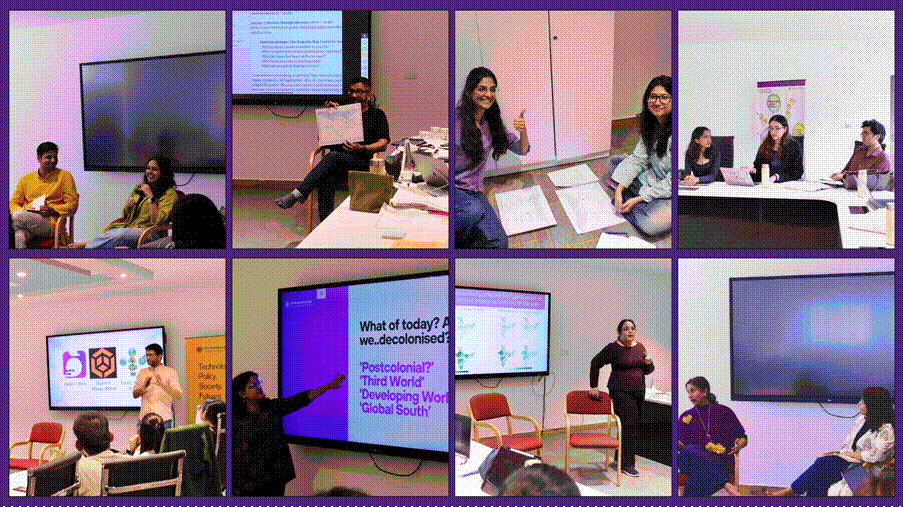
The fellowship began with four in-person Immersion Days in Bangalore, India. The immersion involved an intensive introduction to the questions that shape the lab’s work. The sessions brought together practitioners and researchers from technology, policy, social sciences, design, and grassroots innovation.
Across the four days, fellows engaged with the following questions:
- How change in technology ecosystems is networked rather than linear.
- How dominant AI benchmarks fail to reflect the realities of language, culture, and lived context in the Global Majority.
- How digitisation reshapes everyday economic practices, and why digital systems must be designed with safeguards that protect people from harm.
- What ethical AI design looks like in practice, centring informed consent, meaningful choice, and dignity in community-centred data work.
- Why empathy and listening are foundational to building technology.
- How open-source approaches enable communities to build technology rooted in their own contexts, needs, and values.
- How has privacy evolved from an individual right to a collective concern in the age of data economies and AI.
The Academy Phase
Following the Immersion Days, the fellowship moved into its Academy Phase, a virtual learning programme with global faculty and practitioners, and an internal masterclass series led by the TPI team.
An important element of the Academy has been the sessions on “Ten Lenses on Technology”. These sessions focus on exploring technology through ten disciplinary frameworks: historical, philosophical, socio-technical, economic, legal, geopolitical, decolonial, design, policy, and futures. These sessions are designed on the premise that, to imagine plural futures, we must first learn to examine technology through different intersecting perspectives. The lenses served as a foundational framework for our fellows to look at technology in a context-aware way.
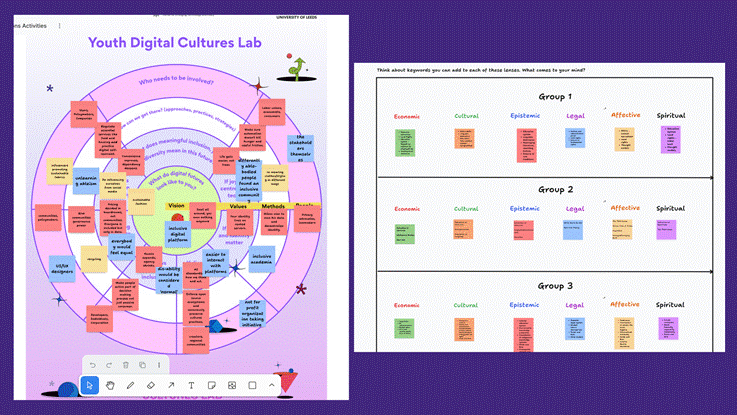
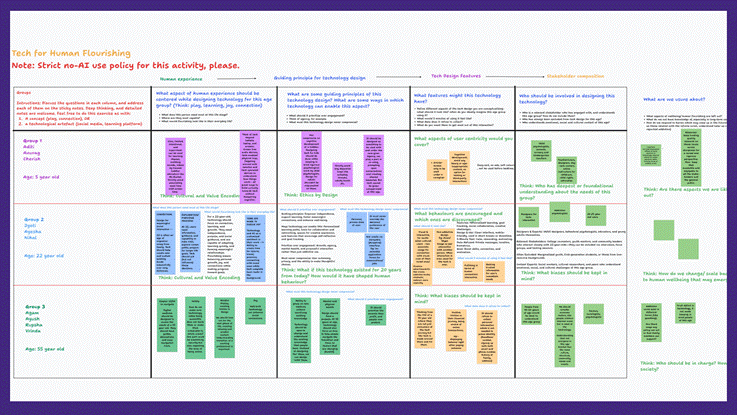
Insights from these sessions were also used to develop participatory activities for our fellows. Some of the activities were:
- Horizon scanning activity to understand what kind of research inquiries emerge when you look at technologies from different lenses.
- Imagining technology futures for people across different age groups. What forms of human experience, guiding principles and tech design features should this technology centre?
- Futures Wheel activity to explore what digital futures look like for young people and what values, methods and people they would centre to work towards these futures.
- Virtual artefact and meme analysis, to understand youth digital cultures.
Our fellows engaged with these participatory exercises to conduct some futures-oriented work. We will share insights from these activities on our digital library in the coming days.
Virtual Sessions with Practitioners

For the Academy, we hosted a series of virtual sessions with researchers and practitioners from many parts of the world. More details on our speakers is available on the YDCL project website.
The sessions were organised around the Lab’s three core themes and engaged fellows with a range of disciplinary perspectives on technology and society.
On questions of AI and knowledge systems we examined how AI systems reproduce Western, individualistic assumptions, raising questions about whose imaginaries shape AI development, and whether expanding representation within existing systems is sufficient or whether more systemic interventions are required. We also connected the discussion on knowledge systems to the broader arc of technology development over the years.
On questions of financial inclusion, we explored India’s Digital Public Infrastructure journey and the conditions under which interoperable, public interest design can enable financial inclusion at scale while also exploring the distinction between access and meaningful use.
On questions of youth, identity, and digital cultures, we explored digital life as lived practice, shaped by everyday routines, social surveillance, algorithmic visibility, and the tension between local identities and global platforms.
On questions of design, behaviour and wellbeing, we examined how design defaults shape human decision-making in ways users are rarely aware of. Fellows also engaged with Self-Determination Theory as a framework for digital wellbeing, examining how digital systems support or undermine autonomy, competence, and relatedness. We also explored speculative prototyping and design fiction as tools for imagining possible futures before they are built.
On questions of research methods and epistemology, we explored participatory methodologies as alternatives that centre community knowledge and experience.
What We Have Been Learning
A few themes have emerged consistently across the Academy:
- The first is that digital inclusion is not a technical problem: it is a social, cultural, and political one. Access to a platform does not automatically translate into agency, safety or joy.
- The second is that non-Western perspectives are not simply underrepresented in digital discourse; they are often excluded by the assumptions embedded in the tools and frameworks that dominate the field. Challenging these assumptions requires building new methods and framework with communities.
- The third is that young people in India have nuanced and often contradictory relationships with digital technology, shaped by language, gender, culture, region and access, and that understanding these relationships requires qualitative and participatory approaches that existing research rarely provides.
What Comes Next
Our YTF Fellows are applying the frameworks and methods developed across the Academy to conduct on-ground qualitative research across India, including Siliguri (West Bengal), Jaipur (Rajasthan), Warangal (Telangana), Vinukonda (Andhra Pradesh), Dehradun (Uttarakhand), and Gorakhpur (Uttar Pradesh). Collectively, these workshops have engaged approximately 150 young people on the ground.
The findings will come together as a co-created research output, developed jointly with the YDCL team and our fellows. We look forward to sharing what this cohort produces next.
The final output from this research will be shared in June 2026, stay tuned!