By Darran Gillan (Founder, TeamG)
I am delighted to announce that I have joined the IN+ Network as a Fellow. The fellowship is cross-sector and embedded in nature and that relational positioning is an important feature worth sitting with. Rather than observing from the outside, I will be working directly with several organisations engaged in digital inclusion with communities navigating a challenging landscape building on work undertaken last year exploring the IN+ Principles in action alongside organisations who have helped shaped the ongoing development of the principles in its current form.
The fellowship begins from a place of genuine curiosity rather than audit. To seek answers to questions such as how each organisation currently understands the IN+ Principles, and how are the principles or the tensions around them already present or notably absent in its structures, practices, and ways of being? From that shared, honest exploration, the work moves toward identifying a mechanism for change something meaningful, co-developed, and specific to that organisation’s context, community, and capacity.
Sustainability the performance of permanence
If you’ve been observing any social media or news outlet in recent months you may have noticed a growing pattern of charities facing financial difficulties, discontinuing longstanding projects and services entering administration. While this has long been a reality in the third sector, it appears to be occurring with increasing frequency. Over the last year, I’ve raised the issue in discussions with numerous community groups and organisations, where a recurring theme from those discussions has been sustainability. When an organisation can count on a stable financial outlook, it becomes far easier to plan and deliver truly impactful, tailored services and projects based on the IN+Principles as evidenced in analysis of the IN+ Principles and Digital Equity in practice report.
However, here’s the thing about sustainability, it just doesn’t exist, at least not in its present sense and perhaps our focus should be on how to embed, bake in or take a blended approach when introducing new frameworks, systems or models in a sustainable way, which at the end of the day, will still cost money, time and capacity to implement, but I think a change is required and here’s why.
“How will your project be sustainable after the funding period ends?”
Sustainability has become the holy grail of third-sector discourse. Almost every grant application poses the familiar question: “How will your project be sustainable after the funding period ends?” Yet if one were to respond with the honest answer “Through another grant from another funder or trust” it would be deemed inadequate, even irresponsible. And yet, across the UK, this is precisely how many organisations are funded including some IN+Funded, IN+ Principal projects survive, moving from fund to fund, rebranding project continuity as innovation, and calling it ‘sustainability.’ The irony, of course, is that the system demands a performance of permanence while funding only the temporary.
The Socratic Problem: What is Sustainability?
If ‘Sustainability’ is a system that demands a performance of permanence while funding only the temporary, then how do we make sense of this contradiction? I turn to an ancient voice with unexpectedly modern relevance, Socrates. Last September after attending the Relational Digital Inclusion: The Politics of Care and Connection event hosted by the IN+ Network I was reminded of how Socrates made it his life’s work to dismantle the comfortable certainties of his time. His method, asking what a word truly means and who has the power to define it, invites us to look beneath the rhetoric. Applied to the third sector, his approach challenges us not to ask how sustainability can be achieved, but what we mean when we claim to pursue it. Only through such questioning can we begin to see whether ‘sustainability’ is a genuine aspiration or simply a convenient illusion that keeps the system intact.
If sustainability means financial independence, how many organisations can truly operate without external grants? If it means solving social problems permanently, how do we imagine ending poverty, racism, or inequality without altering the structures that produce them? If it simply means survival, then ‘sustainability’ collapses into tautology the organisation exists because it exists.
The philosopher Cornelius Castoriadis (1997) warned that societies often ‘enslave themselves with imaginary significations.’ Sustainability in the third sector is precisely such a signification appearing meaningful yet dissolving upon scrutiny.
Sustainability as Temporal, Not Permanent
Third-sector organisations live and die by the grant cycle. Projects are funded in two- or three-year bursts or less, outcomes are measured in months or years, not decades. Mark Fisher (2009) described this as capitalist realism a world where it is easier to imagine endless applications for ‘sustainable funding’ than to imagine a society that no longer requires charity to address systemic injustice or a set of principles in this case in an attempt to create an inclusive, holistic, and responsive model to systematically address the topic of digital equity.
Sustainability here is not permanence but temporality a holding pattern that keeps organisations afloat until the next bid, never liberating them from dependence. In this sense, sustainability is a horizon that retreats the closer one gets.
The Commodification of Sustainability
Socrates might ask, why chase what cannot be attained? The answer lies in political economy. Andrea Cornwall and Deborah Eade (2010) argue that concepts like sustainability are often mobilised as ‘buzzwords’ that depoliticise structural inequality. They function as gatekeeping mechanisms to be fundable, organisations must perform sustainability, regardless of whether the conditions for genuine sustainability exist.
In philanthropy studies, Eve Chiapello (2017) has described this as part of the ‘new spirit of capitalism’ where social justice is reframed through managerial logics of efficiency, impact, and longevity. Sustainability thus becomes commodified a grant-winning keyword rather than a lived reality.
The Sticky Plaster Effect
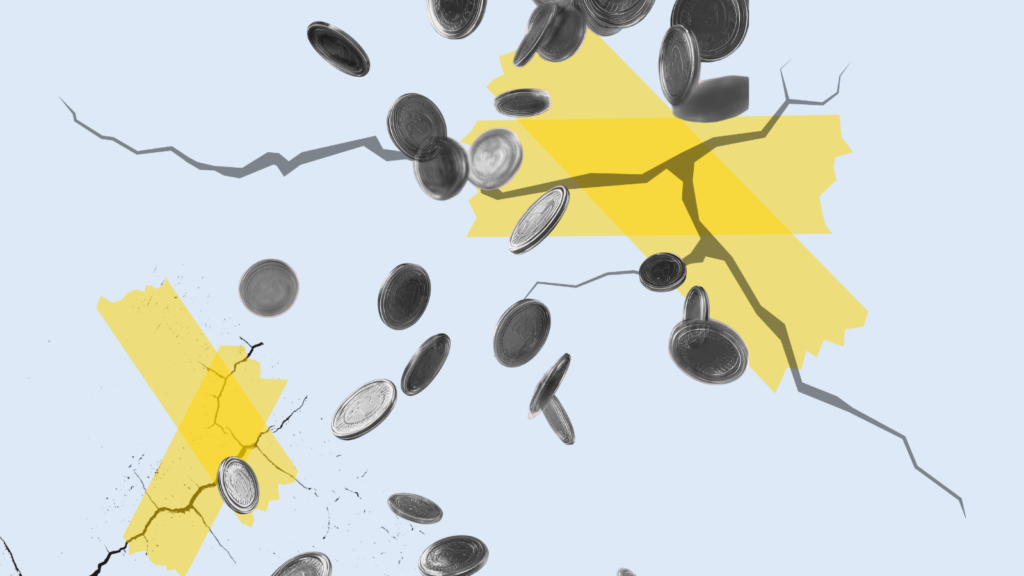
The result? A sticky plaster effect where third sector organisations provide essential care, dignity, and support, yet always at the level of mitigation, never cure. Social policy scholars such as Ferguson and Lavalette (2013) have long argued that voluntary organisations operate as shock absorbers for austerity, stepping in where the state withdraws but never able to alter the conditions that produce need.
This is the unspoken truth the third sector will never ‘fully impact’ in the sense of transforming the root causes of social inequality. To imagine otherwise is to ignore the structural power of governments, markets, and global systems. Sustainability, then, is less a possibility and more a necessary fiction keeping organisations chasing after grants while systemic wounds remain untreated.
The Danger of Unexamined Words
Socrates reminded us that ‘the unexamined life is not worth living.’ Likewise, the unexamined word distorts reality. Sustainability, left uninterrogated, becomes a fetishised end-goal a condition against which organisations are judged but never actually achieve.
The danger then is twofold organisations exhaust themselves performing sustainability rather than pursuing justice; and funders and governments escape responsibility, hiding behind the illusion that if only the sector were ‘more sustainable,’ inequality would somehow resolve itself.
So How Does the Fellowship Resolve this?
This is precisely why I find the IN+ Principals framing of sustainability so refreshing. Rather than treating sustainability as a financial destination, IN+ understands it as a mindset: a commitment to building long-term habits, skills, and practices that empower communities to continue engaging with digital tools effectively even after specific projects have ended. It foregrounds co-design, structural equity, and community ownership, not as ideals but as practical mechanisms, to embed, bake in or blended ways of being.
“The fellowship is, in part, a response to the sustainability illusion not by pretending it doesn’t exist, but by working with organisations to build something more durable beneath it”. Darran Gillan IN+ Fellow
By embedding myself within each organisation, working collaboratively to identify and act on mechanisms for change the fellowship tries to do something different. It doesn’t promise permanence. But it does invest in relationships, practices, and structures that can carry forward and that is, perhaps, the closest we can honestly come to sustainability across sectors.
The question Socrates might really be asking and the one I’ll be carrying through this fellowship is not ‘how do we make the IN+ Principals sustainable across sectors?’ but rather, what are we trying to sustain, and is it worth sustaining?
I look forward to sharing what I learn along the way.